
What Right Does India Have to Oppose the Disclosure of the Indo–Sri Lanka Agreements..?
2026-06-04 1343
The Indo–Sri Lanka Agreements Must Be Revealed to the Nation Immediately
Must Sri Lanka Dance to India's Tune..?
Failure to Disclose Them Is a Violation of National Sovereignty and the Sovereignty of the People
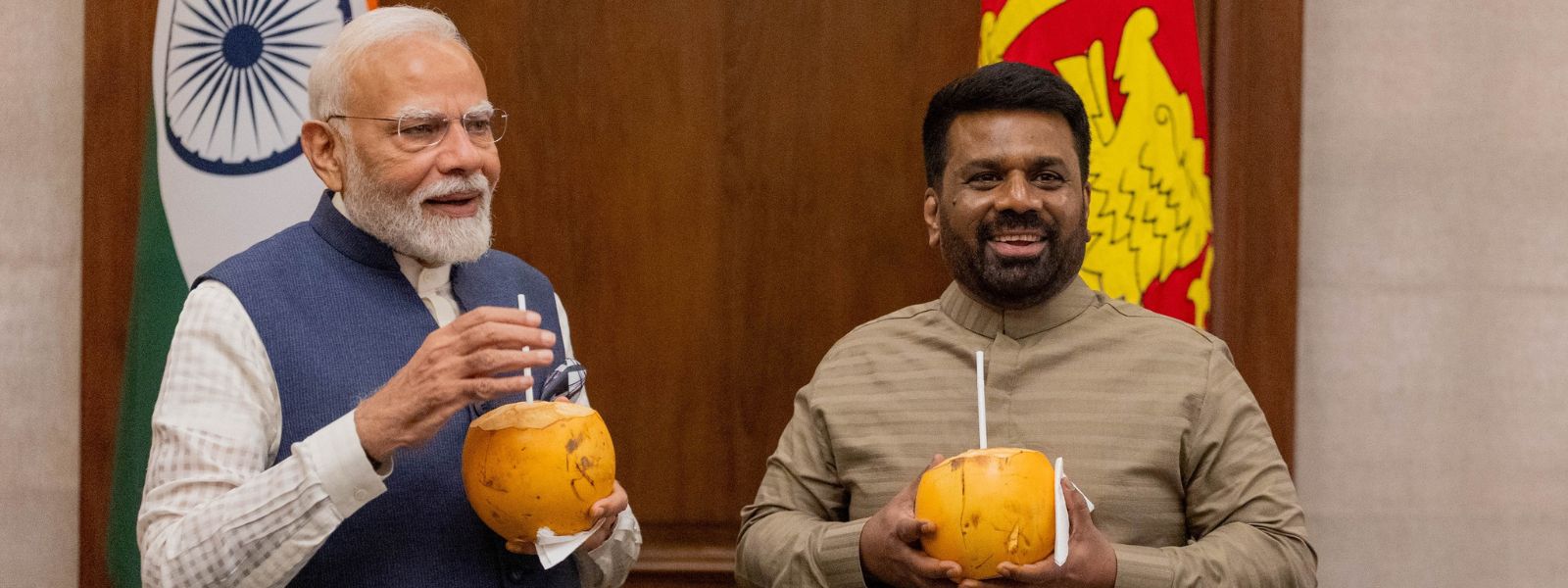
On April 4, during an official visit to Sri Lanka, Indian Prime Minister Narendra Modi was awarded the highest state honor that the Sri Lankan government can confer upon a foreign citizen. President Anura Kumara Dissanayake presented the "Mithra Vibhushana" award to Prime Minister Modi. During this official visit, Sri Lanka and India signed seven bilateral agreements covering various sectors. Some media reports stated that the number of agreements signed was ten. Although more than three weeks have now passed, no information regarding the contents of those agreements has been disclosed to the country.
Among these agreements is a five-year defense cooperation agreement between Sri Lanka and India. Certain government officials have stated that the defense agreement merely formalizes existing cooperation between the two countries, including the provision of services to defense forces and the conduct of military exercises. However, some foreign media outlets have reported that these agreements may contain various underlying objectives. Under such circumstances, every Sri Lankan citizen has a right to know the actual contents of these agreements.
In the past, the Sri Lankan government has signed various agreements not only with India but also with many countries around the world. These include the Sirimavo–Shastri Pact (1964), the India–Sri Lanka Maritime Boundary Agreements (1974 and 1976), and the India–Sri Lanka Free Trade Agreement (1998). At the time these agreements were signed, their contents were fully disclosed to the public, and the legislature was informed accordingly. There have been very few, if any, instances where an agreement signed with India or any other country or institution was withheld from both the public and the legislature.
Among all the agreements signed between India and Sri Lanka, one of the most significant, controversial, and strongly opposed was the Indo–Sri Lanka Accord, signed on July 29, 1987, by President J. R. Jayewardene and Indian Prime Minister Rajiv Gandhi. J.R. decided to involve India—despite its support for the separatist insurgency in the North and East—in efforts to resolve the conflict. India pledged to disarm the LTTE militants and promised to deploy Indian troops to Sri Lanka for that purpose. J.R. agreed to establish Provincial Councils, merge the Northern and Eastern Provinces into a single administrative unit, and work toward a lasting peace. He also agreed to jointly develop the Trincomalee Oil Tank Farm with India.
At the time, India viewed the United States as a rival power. Consequently, J.R. also agreed to place restrictions on the operations of the Voice of America in Sri Lanka. He knew very well that the agreement would provoke significant public opposition. That reality became evident at the very moment of its signing. A Sri Lankan naval rating attacked Rajiv Gandhi during the guard of honor, and Gandhi narrowly escaped serious injury. A few days later, J.R. himself narrowly escaped death in a bomb attack carried out in Parliament by a member of the Janatha Vimukthi Peramuna. At a gathering held afterward to congratulate them on surviving these incidents, the then Speaker reportedly remarked that those who bring peace should be blessed with heavenly rewards. Responding to this, J.R. reportedly said that Rajiv Gandhi had missed going to heaven by a few inches, while he himself had missed it by only a few seconds.
These incidents clearly demonstrated the intensity of public opposition to the agreement. Nevertheless, within three days of signing it, J.R. released the entire agreement and all related documents to the public. It was during this period that the JVP launched strong anti-Indian campaigns, declaring that it would drive out the “Indian monkey army” and even targeting individuals who sold Bombay onions as a form of protest.
J.R. was fully aware that provisions such as the establishment of Provincial Councils, the merger of the North and East, and the deployment of Indian troops could provoke severe public reactions. He also knew that restrictions on Voice of America could alienate countries such as the United States. Yet he published the agreement and all related documents in full, without omitting a single word. In doing so, he affirmed the right of both the public and the legislature to know the contents of such agreements.
It is also important to consider the approach taken by Ranil Wickremesinghe when negotiating Sri Lanka’s Extended Fund Facility agreement with the International Monetary Fund. After the country declared bankruptcy, the government was compelled to accept a number of difficult measures as part of negotiations aimed at economic recovery.
The increases in fuel and electricity prices were among the consequences of these agreements. Tax increases were another policy commitment. He also agreed to restructure state-owned enterprises. Nevertheless, the IMF–Sri Lanka agreement containing these commitments was made public by Ranil Wickremesinghe, and he facilitated a parliamentary debate on it. In many countries, governments attempt to conceal such agreements with the IMF from the public for as long as possible. Yet President Ranil Wickremesinghe showed no reluctance in presenting all the details to both the public and the legislature.
There have also been instances where the current government suggested that those seeking information should submit requests under the Right to Information Act. However, the public has an inherent right to know the full details of any agreement entered into by the government with a foreign country or institution on matters affecting the nation. Likewise, it is the responsibility of the government to present such agreements to the legislature and obtain parliamentary approval. One of the strongest criticisms previously made by the National People's Power and the JVP against earlier governments was their alleged lack of transparency.
The harmful consequence of withholding information about these agreements is the risk that misinformation and speculation will spread among the public. One YouTube channel claimed that the government had even agreed to hand back Katchatheevu Island to India. There have also been suggestions that Indian weapons manufacturing could be linked to facilities associated with Sri Lankan ports. Whether such claims are true or false, the only way to provide clarity to the public is for the government to disclose the contents of the agreements immediately. The public naturally wonders why these agreements are being withheld. Some have even begun to suspect that they may contain commitments more controversial than those found in the J.R.–Rajiv Accord.
The National People's Power presented a policy manifesto to the public during both the presidential and parliamentary elections. Through that manifesto, it sought public approval for its policies regarding national issues, foreign relations, and governance. Therefore, it is important to remember that the government has not received a mandate to deviate from those policies or act contrary to them.
Statements made in the past by President Anura Kumara Dissanayake and other JVP leaders are now being widely recirculated on social media. Their previous opposition to issues such as electricity interconnection with India, the construction of an oil pipeline, the development of the Sampur Power Plant, and the transfer of the Trincomalee Oil Tank Farm to India is frequently contrasted with the positions they appear to hold today. Social media platforms continue to highlight these contrasts repeatedly.
Under such circumstances, the government's responsibility is not to continue concealing these agreements but to publish them, present them to Parliament, and obtain legislative approval. To claim that India does not consent to the publication of these agreements is, it must be argued, an affront to Sri Lanka’s sovereignty and to the sovereign rights of its people, reducing both to a matter of ridicule.
Former Senior Professor
Department of Economics
University of Kelaniya
– Sunanda Madduma Bandara –




Lanka Newsweek © 2026